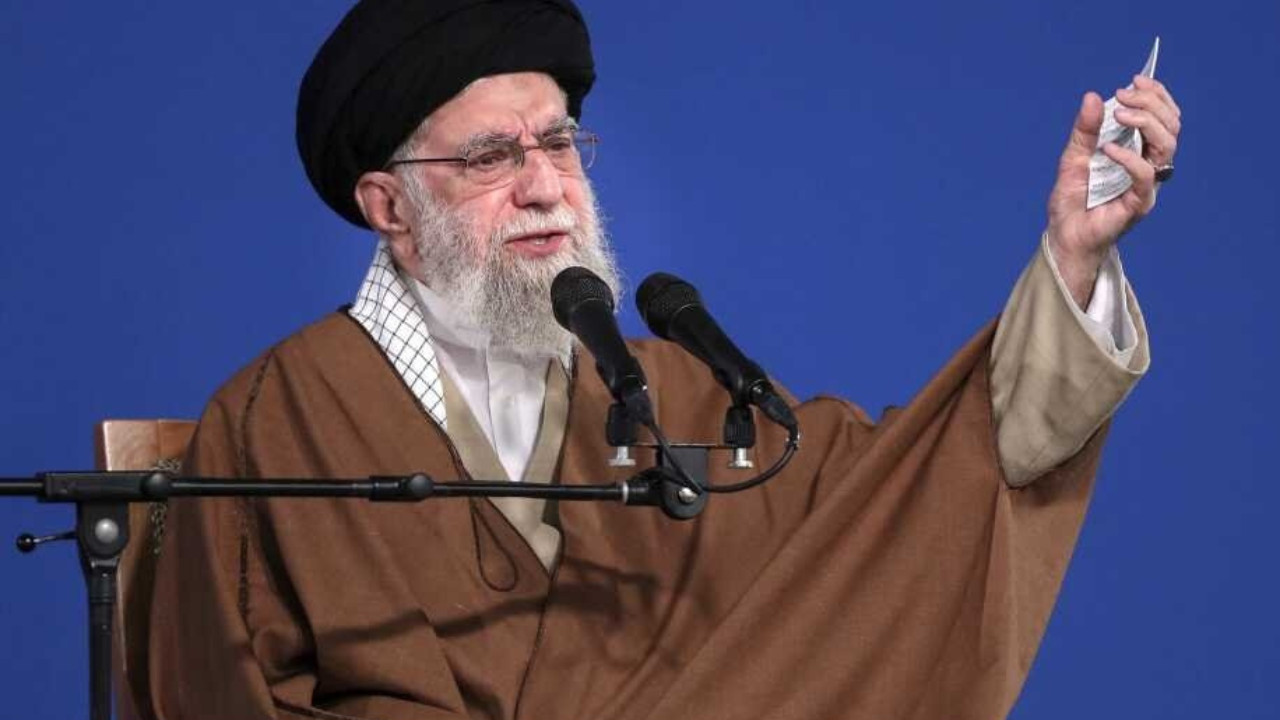
A palpable silence had descended upon Alipur village following reports regarding the assassination of Iran's Supreme Leader, Ayatollah Ali Khamenei. (Image X @s_afreen7)
Alipur (Karnataka): The United States and Israel have jointly launched a war against Iran, the repercussions of which are being felt across the entire world. Against this backdrop, we turn our attention to Alipur—a small village located in the Gauribidanur taluk, approximately 90 kilometers from Bengaluru. Read on to discover its connection with Iran.
A palpable silence had descended upon Alipur village following reports regarding the assassination of Iran's Supreme Leader, Ayatollah Ali Khamenei. Shops remained shuttered, work came to a standstill, and the villagers offered special prayers for Khamenei.
The local residents here were mourning the passing of Iran's Supreme Leader—a figure with whom, they assert, their town shared a deep and profound bond. For this Shia-majority village, home to a population of roughly 25,000, the Supreme Leader of Iran holds a very special place.
Alipur is renowned for its burgeoning gemstone trade, yet it is equally recognized for its long-standing religious and cultural ties with Iran. Several streets within the village have been named after Iranian cities such as Tehran, Qom, and Shiraz. Many families send their children to Iran for religious studies and higher education—including MBBS programs—finding the country to be both an affordable and culturally familiar destination.
Syed Natiq Alipuri, a writer and local historian from Alipur, remarked that the bond with Iran runs exceptionally deep. "Our village's relationship with Iran extends far beyond the realm of the Shia faith," he stated. "These ties are civilizational, historical, and deeply emotional."
Alipuri recalled that Ayatollah Khamenei had visited Alipur in 1980. During that visit, he envisioned a hospital for the town and laid its foundation stone. Alipuri noted that, for the people, that visit was not merely a symbolic gesture; it was a promise—one that eventually transformed into reality. Alipuri stated that many people in the village are in shock following the news of Ayatollah Khamenei's passing. Alipuri expressed his grief over the attack on Iran and the martyrdom of Ayatollah Seyyed Ali Khamenei. He was known for raising his voice on behalf of the oppressed, particularly the people of Palestine.
He remarked that Khamenei's departure is a painful loss for many. He also condemned reports of a bomb blast at a school in Iran. He asserted that when children are killed in a school, it is not merely an attack on a single nation; it is an attack on humanity itself. Such acts must be condemned, regardless of who is responsible for them.
One of the clearest symbols of Alipur's connection with Iran is the Imam Khomeini Hospital, which is administered by the Imam Khomeini Medical Trust. Established following Khamenei's visit, this hospital has been serving the region for decades. The hospital was built with the assistance of Ayatollah Seyyed Ali Khamenei, who visited Alipur in 1980.
He had envisioned establishing a hospital in the town and laid its foundation stone during that very visit. It was a memorable moment that underscored the depth of his bond with the community. The hospital provides medical care to people, transcending the boundaries of religion or caste. Residents attest that it has become a lifeline for poor and needy families in Alipur and its surrounding areas.
Recognizing healthcare as a fundamental human right, the hospital—founded upon this very principle—continues to expand its services and adopt new medical technologies. A dedicated team of doctors, nurses, and staff members focuses on providing personalized care to patients. For many villagers, this hospital stands as a living testament to a relationship that blossomed into a legacy of service to humanity.
The transformation of Alipur began in the 1970s, when it shifted its focus from agriculture to gemstone trading. Situated in a gem-rich region, this village established trade links with markets across Rajasthan, as well as international hubs such as Bangkok, Singapore, Sri Lanka, and Dubai. Syed Inayat Ibn-e-Hasan, a proprietor in Alipur’s gem business, noted that the gem trade has long served as the linchpin of the local economy. "The gemstone business has been the mainstay of the village's economy for decades," he stated.
His clientele spans the entirety of India and extends internationally to regions including Dubai, Sri Lanka, and Southeast Asia. The Alipur Gems and Jewellery Traders Association boasts over 270 registered traders and supports the livelihoods of more than 2,000 families. However, the ongoing conflict has disrupted trade operations.
"We have transitioned from working out of our homes to operating in small-scale workshops," Hasan remarked. "The war has made things difficult. Shipments are delayed, and orders remain uncertain... yet, we are managing to get by."
Many students studying in Iran have returned home due to security concerns, while others are reconsidering their future plans. "We are praying for peace, but we cannot turn a blind eye to what is unfolding," Hasan said.
Culturally, Alipur reflects its unique historical heritage. Urdu is widely spoken; some residents are fluent in Persian, and many women have adopted the Iranian style of hijab while simultaneously upholding traditional Indian Muslim customs. "Our bond with Iran encompasses history, culture, religion, and economics," an Alipur resident observed. "It is a tapestry of shared memories and lived realities that continues to define Alipur's place in the world."
He added that, as global tensions escalate, this tranquil village in Karnataka finds itself mourning not merely the passing of Iran's Supreme Leader, but—more profoundly—the loss of a figure inextricably woven into the very fabric of its own narrative.




Copyright © 2026 Top Indian News